
Key facts: Flash Flood Cleanup in Bear Creek
- A KRLD report of August 24, 2022 quotes a Cedar Hill councilwoman saying a creek flooded and damaged homes along an entire street; it did not name them.[1]
- One resident in that report bought a wet vac to start clearing her house.[1]
- Ready.gov warns that floodwater can be contaminated and contain dangerous debris.[2]
What's different
What creek water leaves behind
Rain through a roof wets a house. A creek flood fills it with something else. Silt settles on floors and inside wall cavities, and it clings to everything it touches. Debris ends up against walls and doors. There may be fuel, lawn chemicals or sewage in the mix. The EPA warns that flood water can contain microorganisms or chemicals that affect health.[3] That's why it's treated as a contaminated-water job from the start, however clear it looks.
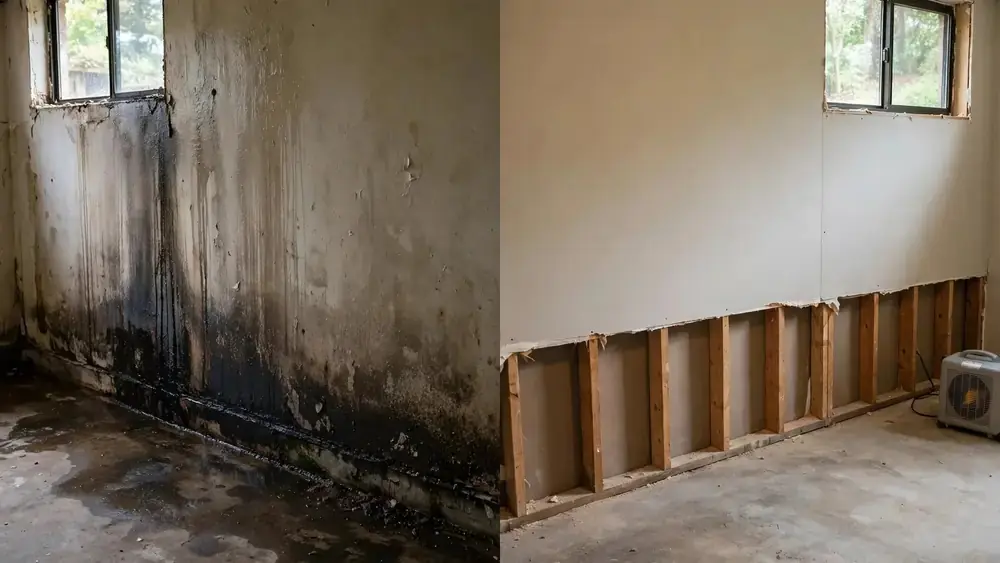
It also recedes, which can be misleading. Once the water is gone, the place may seem less bad than it is. But wet insulation and silt-filled walls keep their moisture, and in warm weather mold can start soon after. The EPA says materials that stay wet for more than two days usually become moldy.[3]
The first days
The first days after creek water
- 1
Wait for the all-clear
Don't return while roads or banks are unsafe.
- 2
Have the power and gas checked
Don't operate anything that was under water.
- 3
Photograph it all
Outside and in, with the water line in the picture.
- 4
Call your flood insurer, if you have one
Say that water rose from outside.
- 5
Take out what's soaked
Remove carpet, pad and soft furnishings, listing each thing.
- 6
Shovel silt while it's wet
Keep it out of the storm drains if you can.
- 7
Cut walls above the wet line
Do it with a contractor's guidance, using a meter.
- 8
Clean, sanitize and only then dry
Fans come last.
Belongings
Sorting belongings after a creek flood
| Item | Usual decision | Note |
|---|---|---|
| Mattresses, pillows | Discard | Cannot be fully cleaned |
| Upholstered chairs | Usually discard | Ask a specialist about valuable pieces |
| Solid wood furniture | Clean and dry slowly | Avoid direct sun |
| Clothing | Often washable | Hot wash where the fabric allows |
| Food touched by water | Discard | Includes sealed cans if damaged |
| Photographs and papers | Rinse and air-dry if possible | Freeze if you can't deal with them yet |
| Electronics | Do not power on | Ask a repairer |
Outside
Yard, fence and creek bank
Cleanup outside the house has its own hazards. Silt can hide sharp debris. Banks may be undercut and may give way, even after the water falls, so stay back from the edge. Keep children away until the yard is cleared. Fallen trees and limbs near power lines are a job for the utility or an arborist.
Think about where debris goes. Pushing it back toward the creek can create a blockage that makes the next flood worse for you and everybody downstream. Ask the city about storm debris collection after a big event.
- Stay back from banks
- Watch for sharp debris
- Keep kids out of the yard
- Don't push debris into the creek
Maps and cover
The flood map and your next steps
FEMA's flood maps page leads to the Map Service Center and your community's map. Check it after a flood if you never have, and bear in mind FEMA's point that no area is entirely free of flood risk.[4] Then look at insurance. Triple-I says flood damage falls under a separate policy, with a 30-day wait.[5] That rules out buying cover when a storm is forecast, but a flood is a good reason to get a policy before the next one.
A sample home policy form also excludes surface water and overflow of a body of water.[6] Texas forms may differ, but expect that question to come up.
Help
Help available after a big flood
After a large regional flood, there may be disaster assistance, and voluntary groups may be working in the area. Look for official announcements from the city and county. Be careful with anyone who appears at your door offering to handle everything. Get a written scope, check who they are and don't hand over your insurance claim rights without reading what you're signing. Neighbors are a useful source of names, and they're also worth checking on, especially older people living alone.
Rebuilding
Before rebuilding near a creek line
- Wait for dry readings in framing and slab.
- Ask the city whether rules apply to substantial repairs in a mapped flood zone.
- Consider materials that handle wetting better on lower walls.
- Move outlets and equipment higher where you can.
- Keep all your records from this flood in one place.
Further reading
Where to go from here
The main flash flood cleanup page covers the general process and the Bear Creek page has local drainage notes. If a drain line has also backed up, sewage backups in Bear Creek explains what changes. For the insurance detail, read which insurance applies.
The week after
The week after: what tends to get missed
By the end of the first week, most attention has moved to the visible rooms. That's when to check under cabinets, inside closets, behind appliances and in any ducts at floor level. Look at the water heater and air handler again, and confirm each has been checked. Mark on a calendar when your drying readings were last taken, and ask for the next ones. Keep your flood claim paperwork in one folder.
Keep records
Keep your photos in date order
Keep your flood photos in date order. Add one each day as work moves along, including the empty rooms and open walls. That sequence shows what was removed and why, and it's useful later when you rebuild, make a claim or sell the house.
Pacing
Pace the work
Do one room at a time, and take regular breaks in the heat.
Questions
Bear Creek creek flood questions
Can I go back into my house right after a creek flood?
Wait until authorities say it's safe, then make sure power and gas have been checked. Wear boots and gloves when you go in, watch for damaged floors, and keep children and pets out until the cleanup is done.
Do I need to take out all my walls after a creek flood?
Usually only the wet sections, cut above the wet line, though silt inside cavities pushes that decision. A contractor uses a moisture meter and looks inside the wall to decide how far to go.
What happens to the mud I shovel out?
Don't push it back into the creek or storm drains if you can avoid it. Pile it away from the house and follow any city instructions for flood debris. Photograph it first if your insurer might want to see it.
Can I get flood insurance after my house has flooded?
Generally, you can apply, though a waiting period usually applies and terms may vary. Ask an agent who handles flood cover, and check your community's map for what zone you're in.
